The Problem
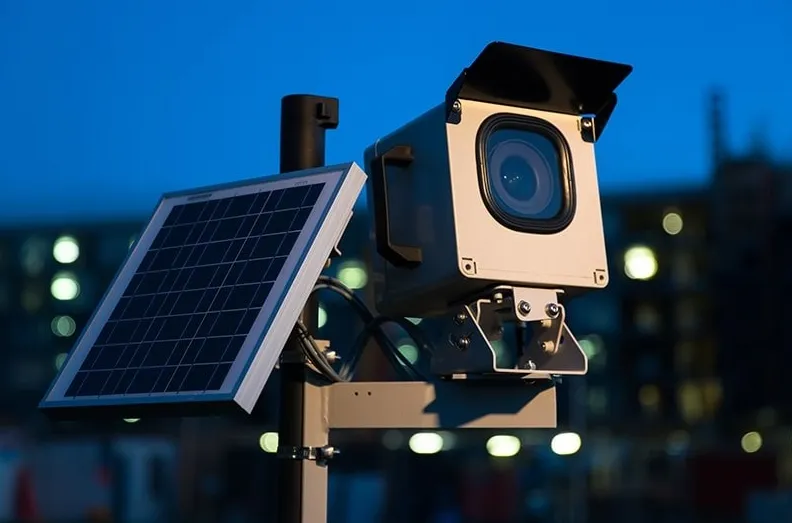
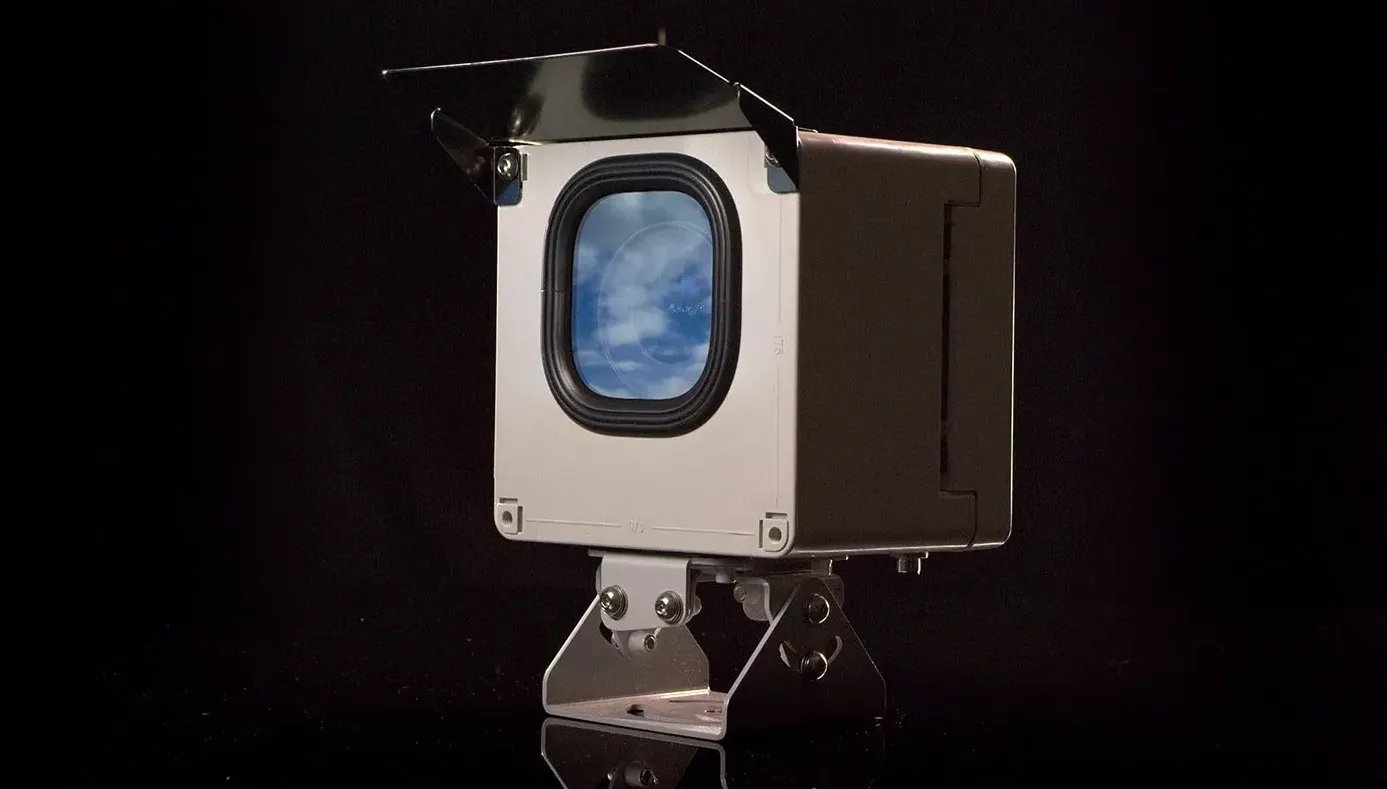
Time-lapse photography projects run for months or years in exposed outdoor environments. Existing enclosure solutions required physically removing the camera to access the controller for maintenance or swap-outs — which meant the camera had to be repositioned and recalibrated on return. For time-lapse work, where consistent framing continuity is fundamental to the validity of the footage, this was a recurring operational problem. The brief for the Mach II was to design an enclosure that could be fully serviced in the field without disturbing the camera.
Constraints That Shaped the Design
Field conditions
Units are deployed across a wide range of environments — extreme heat, sub-zero temperatures, sustained moisture exposure. The enclosure had to meet and exceed industry durability standards, not just survive short-term exposure.
Camera positioning continuity
Any design requiring camera removal to access the controller would create repositioning errors on reassembly. The mechanical architecture had to decouple the camera from the maintenance workflow entirely.
Long design lifetime
PhotoSentinel units are deployed on multi-year projects. The company needed to be able to supply replacement parts — particularly the SSD interface — for units manufactured at any point in the product’s life, not just current production.
Field serviceability
Technicians servicing deployed units in outdoor conditions need to disconnect and swap hardware quickly. Designs requiring tools or complex reassembly represented a real and recurring operational cost.
Decisions and Reasoning
Modular internal carriage
The central mechanical decision was to decouple the controller and camera from the enclosure via a removable carriage. The carriage extracts cleanly without touching the camera mount, preserving the camera’s position and alignment through any service event. This requirement drove the entire internal geometry of the enclosure — everything else was designed around making that extraction path work cleanly.
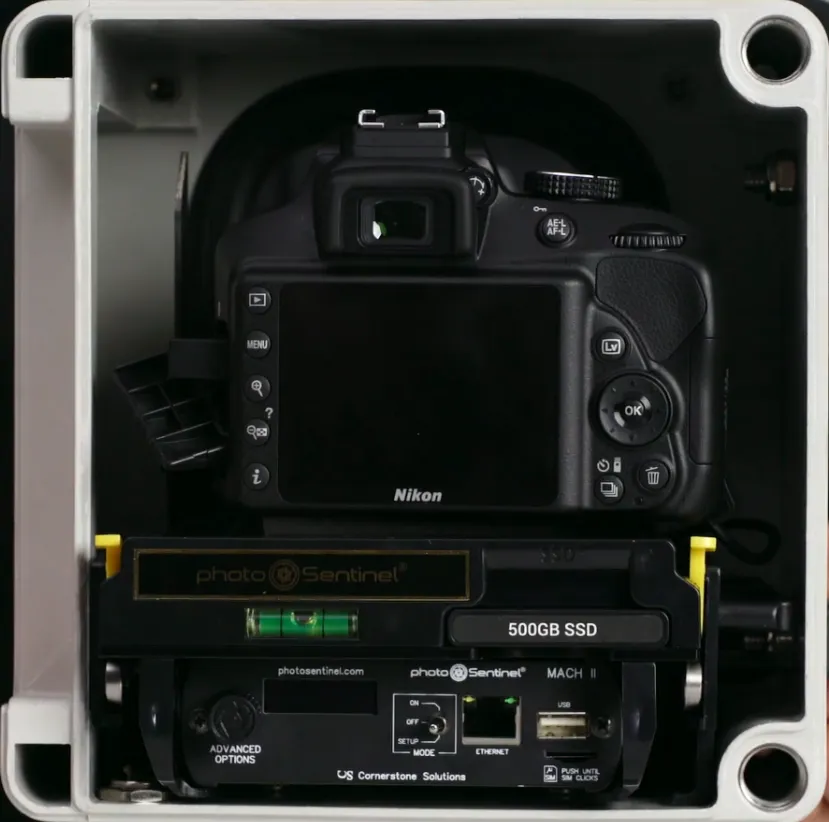
The carriage extraction sequence is demonstrated in PhotoSentinel’s install guide video, which shows the full open, extract, and reinsert workflow in a field context.
Quick-disconnect power system
Controller and camera power connections were designed as a quick-disconnect rather than wired connections requiring tools. In the field, a technician can pull the carriage, swap or test the controller, and reconnect without wiring errors or extended exposure. It also enables swapping entire controller assemblies as a fault response rather than attempting in-field diagnosis and repair.
Custom SSD enclosure and receptacle
Off-the-shelf SSD mounting solutions weren’t designed for the Mach II’s form factor or its expected service life. A custom receptacle was designed to maintain the same physical connection interface across the entire production run — meaning replacement assemblies could be manufactured and supplied to customers regardless of when their unit was originally produced. This protected customers on long-running deployments from obsolescence risk on a component they’d need to replace over time.
Structured vendor sourcing
Components for the enclosure, carriage, and SSD system were sourced with durability and supply continuity as the primary criteria. Vendor collaboration during sourcing was used to validate parts against environmental requirements before committing to the BOM, rather than discovering failures during testing.
Outcomes
The Mach II passed environmental testing across temperature range and moisture resistance criteria and shipped as a production product. The modular carriage, quick-disconnect power, and custom SSD system delivered the field serviceability the brief required.
The clearest signal of design longevity: the parts and features developed for the Mach II are still in use in the successor product, the ‘Tempo’, without redesign.